- In: Breakfast | Dessert | Homemade | Pumpkin | Quick bread | Sweets
- Leave a Comment

One early evening this September I stepped outside, took a deep breath, and inhaled a familiar aroma that I hadn’t been acquainted with since this time last year. A feeling of excitement came over me as I continued to walk up Fifth Avenue, and I realized that this certain smell was autumn.
What does that mean – to smell like autumn? It’s hard to verbalize, but it smells light, cool, and crisp, as though the air has gradually calmed down from exposure to the summer sun’s bright rays. It is redolent of the leaves changing from deep and bright greens to warm red orange and amber shades, and it is aromatic of something that is slightly toasty and nutty, yet elusive in some way.
Autumn in the Northeast is completely unlike what I was used to growing up in San Francisco. A San Francisco autumn was unremarkable; the idea of leaves changing color was completely novel to me when I moved to the Boston area in 2004. I went to school at one of the most beautiful college campuses in the area and was able to fully experience a real New England autumn complete with Harry Potter-like Gothic-Georgian architecture in the background. The leaves slowly but surely changed color. I had no idea that a green leaf could turn into a deep magenta or purple shade, or that the same leaves that were orange could also become yellow before they crisped up and became brown. It was as though every day when I walked outside, I was constantly stunned by endless transformations and beauty.

Throughout the last seven years, I’ve watched with wonder as I’ve passed children in parks embracing autumn’s arrival. The glee with which they delight in autumn has never failed to bring a smile to my face – the way they thrash around in the leaves, rolling in them, tossing them up with their hands and kicking them and crunching them. I’m honestly not sure what warms me more – seeing the kids’ carefree delight or observing the parents watch their children, realizing how amazing it is to derive joy from life’s simple pleasures. Many times, I’ve been tempted to join in on the fun and jump up and down in the leaves with them, but then the self conscious adult side of me takes over and I decide that it wouldn’t be the smartest thing to do.
I’ve spent the last few months experiencing autumn in urban areas in New York like Union Square, Central Park, and Madison Square Park, but have also been able to see it by leaving the city and going hiking in Mohonk Preserve and wandering around the Berkshires in Massachusetts. Autumn in the Northeast is the most spectacular when you are outside of the city and completely immersed in nature. The few times I have left, it’s also helped me clear my head temporarily and just think about two of the simplest yet most complex things – love and life itself.

I always want to say that autumn is my favorite season, not just for that amazing smell that fills my nostrils as soon as September hits, and not just for the dramatic foliage, but also because it signifies the beginning of the holidays – Halloween, Thanksgiving, and Christmas – and the traditions I embrace each year. Carving jack-o-lanterns, cutting up different types of squash for soup, getting together with family and friends for extravagant and gluttony turkey meals, decorating Noble Fir trees with my newest and oldest Christmas ornaments, and making egg nog and holiday cookies; it’s everything I love about life condensed into three short months of the year. If we just added some sun and warmth, it really would be the most perfect time of the year (I am slightly conflicted, though, because I also love watching the snow fall and lightly dust itself onto the city around me).
Autumn also means that I can get back to my favorite place in the house, the kitchen, and begin baking again. I bake the most during the autumn and winter, and one of the things I’ve been making without fail for the last four years has been pumpkin bread.
The spice combination in this bread – cinnamon, nutmeg, and ginger, combined with cranberries and toasted nuts, is one of the best ways to welcome autumn back into our lives. That spicy smell wafting through my apartment just conjures up all of the memories I have of every autumn I’ve spent on the East Coast.

Pumpkin bread is a really simple quick bread to make. Canned, unsweetened pumpkin is readily available at almost any grocery store, and I can speak from experience when I say that cutting up, pureeing, and straining a real sugar pumpkin for your pumpkin bread or pie is not really worth the effort. The taste will be exactly the same, so you should save yourself some trouble and just buy the canned stuff. The canned stuff is really good, so there’s no reason to dismiss it.

I always like to add either dried cranberries and/or toasted, chopped walnuts or pecans to my pumpkin bread. Both dried cranberries and toasted nuts always remind me of the autumn, and what’s better than making an autumn sweet bread taste even more like autumn?
I got this recipe from the resident director at my dorm in college. He loved to bake and cook, and in the autumn, he made several loaves of this pumpkin bread and shared it with all of us. It was love at first bite – I immediately asked if he’d be so generous as to share the recipe with me, and share he did. Although I’m no longer in touch with him, his baking legacy lives on with me and everyone else I love who gets to benefit from the fruits of my autumn baking.

Pumpkin Bread with Cranberries and Walnuts
Adapted from the 2005-2006 Stone Davis Resident Director’s recipe collection
- 2 C. sugar
- 1 C. vegetable oil (canola or corn)
- 3 eggs
- 2 C. cooked/canned unsweetened pumpkin
- 3 C. flour
- ½ tsp. baking powder
- 1 tsp. baking soda
- ½ tsp. salt
- 1 tsp. ground ginger
- 1 tsp. cinnamon
- 1 tsp. nutmeg
- 1 tsp. cloves (optional)
- 4 C. dried cranberries
- 1.5 C. toasted, chopped walnuts or pecans
Preheat the oven to 325 degrees F.
Combine the sugar and vegetable oil in a large mixing bowl; mix well. Add the eggs, one at a time, until incorporated. Combine the all of the dry ingredients in a medium mixing bowl. Mix the pumpkin into the egg mélange, and when combined, gradually add in all of the dry mixture. Stir in the cranberries and nuts. Put into two greased loaf pans. Bake the loaves for 1 hour.

- In: Cookies | Dessert | Food adventuring | food travel | France | Gazpacho | Salad | Tea | Travel
- 1 Comment

It’s been over two years since I have updated this blog. I stopped mainly because my new job at the time was forcing me to work long hours, and also because it already required me to be in front of a computer for so many hours of the day that once the weekend came, the last thing I wanted to do was be in front of a computer again.
A lot of things have happened in the last two years – lots of new experiences, realizations, and traveling. The most recent and notable travel experience I have had was my first time in Western Europe (France, Italy, Greece, and Turkey). I spent two and a half weeks this summer exploring Europe, and my first stop was in Paris. I’d wanted to come to Paris for as long as I could remember, and this past summer, it finally became a reality. When I had to chose a language to study in freshman year of high school, I unhesitatingly chose French. Although those language skills are close to dead now, during those four years studying French, I gained a deep love of French culture and ways of life. The “je ne sais quoi” leisurely lifestyle and appreciation of fine art and gastronomy were big reasons I’ve been so drawn to French culture. In my mind, the French have a deep understanding of the most important thing in life, and that is the art of living and living well.

Paris is a city that likes to enjoy a glass of wine at every meal, a city that relishes its two-hour lunch breaks, and a city that encourages seeing and walking to appreciate her complete beauty. She is a city that is somehow so green that when I look around at all the lush, vibrant shrubs and trees that have been trimmed and hedged to perfection, I sometimes think that someone just took a can of forest and pine green spray paint and had a field day running through her streets.
Our first night, we walked from the Champs-Elysees to the Tour Eiffel. Although I had seen it so many times in TV shows, movies, postcards, and photos, seeing the Tour Eiffel in person was like a revelation. I was so stunned by its massive size, curves, and light. I felt different emotions as I walked around it and along the Seine, but most of all, I felt an overwhelming sense of gratitude – gratitude for the fact that I was so privileged to be able to visit one of the most stunning cities in the world, gratitude for all of my life’s experiences, both painful and happy, and gratitude for the people who I have loved and who have loved me and contributed to who I am now. In a city I had never before visited, I began to feel nostalgic and introspective.
As these feelings of nostalgia and introspection fell upon me, I realized exactly how much I missed writing, and almost every day that I was in Europe, I blocked out an hour or two to write about my experiences and feelings while there. In some way, you could say that going to Europe helped me find a part of myself again. Traveling through such beauty gave me an overwhelming sense of gratefulness and happiness in a way that I’d never experienced before.

Paris is one of those places that people visit and have extremely high expectations for. We hope it will live up to all of the hype that television shows and movies have built around it. We expect every building to be stunning and colossal, every work of art to be breathtaking, and every croissant to be buttery, flaky, and melt in your mouth.
Well, not every building was stunning, not every sculpture and painting I saw was breathtaking, and (extremely unfortunately) not every croissant I had was flaky, but I will say that Paris lived up to all of my expectations, particularly when it comes to all things epicurean.

One of the first things I always think about when I remember Paris is Ladurée, the most luxurious and refined pastry and cookie shop in Paris. Ladurée has several locations in Paris and around the world in major metropolitan cities, and just recently (to my absolute giddy delight) opened a shop right here in New York on the Upper East Side. Everything about Ladurée is chic and exquisite, from the jewel-like decor of each shop to the elegant, posh gift boxes (which you have to pay extra for, but if you are a die-hard fan, you should probably just cave in and get one…or two). Ladurée is famous for all of their chocolates, cakes, and sweets, but they are most renowned for their macarons – a cookie made of two little almond meringues sandwiched with a filing between them. Please don’t confuse these with those American coconut cookies. What makes these little sandwich cookies so amazing? Take a look:

The perfect macaron, when you bite into it, should have a small crunch, and then as your teeth dig deeper into it, should be lighter than air. The ideal macaron is light and delicate; it is a meringue, after all, that was piped from a pastry bag, left to sit for a few hours to develop the “shell” on its top to create that tiny crunch in the initial bite. The fillings vary depending on which flavor you get. I can’t decide if I prefer the richer fillings like pistachio or hazelnut cream or the lighter ones like raspberry or orange.
In addition to getting macarons from Ladurée, we also tried them at Eric Kayser and Pierre Herme. The most unique macaron flavor we had was from Pierre Herme – olive oil and vanilla bean. The strong perfume of vanilla was unmistakable, but with the hints of fruity olive oil, the flavor was pretty sensational. You can even see the specs of vanilla bean in the cream filling here.

The Eric Kayser macarons were satisfactory, but honestly, they paled in comparison to the ones we had at Ladurée and Pierre Herme. However, their mini pistachio flavored financiers were incredibly cute and dainty with just the right amount of sweet almond nuttiness.

Oftentimes when friends have come back from France, they say that the cookies and croissants always taste better there than they do here in the States, even when they are thinking about their favorite pastry shops here. I used to think that this was just because they had such great memories of their travels and wanted to immortalize those epicurean experiences in their minds, but then I read an article a few years back that noted that laws in different countries surrounding butterfat (yes, butterfat laws; there really are regulations around this stuff) actually did make buttery baked goods different depending on where you are eating them. By law in the United States, American butter must contain at least 80 percent butterfat, while the minimum for French butter is 82 percent. Many companies in France that make butter even use 83-86 percent butterfat! A few percentage points might not sound like a big deal, but butterfat is the main determinant of butter’s flavor and texture, so every small bit counts.
The best croissant, baguette, and madeleines I had were from a bakery within walking distance of the Sacre Coeur cathedral called Le Grenier à Pain. Apparently in 2010, they won first place for the best baguette in the 17th annual best baguette contest in Paris at la Chambre de Commerce des Boulangers. The croissant was one of the flakiest croissants I’ve ever eaten, with a texture so light that I probably could have stood there and eaten 10 of them without even realizing it. The crunchy exterior was almost addictive.

Many milk and butter companies in the States, such as Vermont Butter & Cheese Company, are trying to use methods to make butter to mimic the tastes and textures of European butter. They actually make butter with 86 percent butterfat. I still haven’t tried it yet, but I intend on doing it sometime soon. Maybe if I do try it out with the next baked good I make, I will succeed at producing a madeleine that was as tasty as this one at Le Grenier à Pain:

France is a carb lover’s dream – everywhere you go, you are surrounded by the most amazing and decadent cookies, cakes, pastries, and breads. Most of the notable bread places we found were along the way to the Sacre Coeur. For our picnic that day, we bought a gorgeous loaf of olive bread from Boulangerie à L’Ancienne.

This place churns out baguette, madeleines, and other pastries and breads all day long. We even saw a man in the front of the shop shaping baguettes. If I had timed him, it probably took him about 15 seconds per loaf to shape and throw each baguette onto the industrial-sized baking sheets. We used our olive bread to make sandwiches that day, and it was probably one of the best olive breads I’ve had. The olives had just the right amount of saltiness, and the bread was soft yet springy. With our pâté and cheeses, these sandwiches made the perfect lunch.

In the midst of all of the croissants, baguettes, and macarons, we still needed to have some real meals while in Paris. To be honest, while we did eat at a few good places with great steak frites, creme brulee, and charcuterie, none of them were particularly memorable or worth writing home about. The one exception to this was our visit to the much loved Mariage Frères Maison de Thé.

For our last lunch in Paris before jetting off to Rome, I knew we had to visit one of the best tea houses in the world. Mariage Frères has several locations in Paris, as well as in Germany and Japan. Mariage Frères is known by tea connoisseurs for its large selection of teas imported from around the world. Each store is laid out in an apothecary style that makes you feel like you are about to make a purchase that might heal an ailment of some sort that you have. We visited the location in Rive Gauche, which is quietly tucked away on a side street in the area.

If you visit one of the tea salons like we did, you can have the privilege of enjoying your own pot of their spectacular tea in a relaxing, beautiful setting. In addition, you can also have breakfast, brunch, or pastries and cake here. Of the prix fixe brunch selections (all in French, so practice your reading and speaking skills!) listed, we choose the Green Line and the Lucky Melodies.
The Green Line came with a beef filet tartare, a gazpacho, and a salad of long, elegant romaine leaves and roasted, marinated tomatoes, a glass of Mariages Frere’s very own namesake champagne. Lucky Melodies came with a chicken salad that redefined chicken salad for me – a mix of beautifully cut romaine leaves, radicchio, large slices of chicken breast, red beets, with an intensely fruity olive oil and nut dressing. This salad was like a work of art. Both sets came with freshly squeezed grapefruit and orange juice, a buttery berry scone, and a fruit muffin with Mariage Frères tea-infused fruit jellies and butter.

For tea, he had a Sweet Shanghai – a subtle green tea with lychee notes – iced, and I had the Rose d’Himalaya, a first flush Darjeeling tea perfumed with rose petals. The deep red color of the Rose d’Himalaya was so gorgeous in my little tea cup. For dessert, we shared a slice of the matcha green tea tart, which was intensely green tea flavored and silky, and a yuzu tart, which was extremely tart. I don’t think there was a single thing that we did not enjoy the taste or presentation of in this meal. Even the service was impeccable.

The highlights for the meal were the fruit and tea-infused jams, the chicken salad, the beef tartare, the flute of champagne, which had more depth and complexity than any other glass of champagne or prosecco I’ve ever tasted, and the green tea tart.

The jams we had with our scones and muffins were amazing. Both had citrusy, floral notes and were infused with tea, and the texture resembled more of a thick jelly than a jam. Every aspect of this meal at the tea salon was memorable, and when I look back on Paris, this was definitely one of the most unforgettable parts of the trip.

Writing about Paris makes me miss it even more and want to impulsively book a flight to go back there just to sit and linger in the tea salon, enjoying a cup of tea and a scone with one of those succulent fruit gelées. In some ways, my outlook on life has been changed by the time I spent in Europe. There are a lot of little joys in life that we take for granted, and sometimes when things get very chaotic and busy, we tend to forget those little things that make life so amazing. Maybe we would all be a little bit happier and more satisfied if we could just take a short break from this everyday life we live, jet off to Paris, and experience an afternoon of respite in a tea salon as tranquil and beautiful as Mariage Frères’.
Whatever you do when you go to Paris, make sure that you indulge in as many croissants, macarons, baguettes, and tea (if that is your fancy) as possible. Eating in Paris is an experience in itself that everyone should embrace. I certainly did.
Vermont – The Wondrous Maple Land
Posted on: August 24, 2009
- In: Brattleboro | Food adventuring | food travel | New England | New England eating | Savory | Sweets | Vermont
- 1 Comment

Before I moved to the East Coast and actually lived a summer here, I’d never really known about what a “real” summer was like. Back in San Francisco, the land of everyday fog and households ignorant of the need of air conditioners (if you lived in 50-60 degree Fahrenheit weather year-round, would you need central AC?), I lived in complete ignorance of what it is like to change living habits based on the seasons. We never limited ourselves to cooking stews and braises for the winter or making lemonade and sorbets in the summer. We could do whatever we wanted year round, and our kitchen would be at about the same temperature. Cooking was cooking.
Well, I’m no longer in San Francisco now. In my apartment in New York, in which I have lived for over a year, which I will also tell you until yesterday had no AC (my landlord likes me now, so he is loaning me one for the duration of my stay here), if you want to bake blueberry muffins or even do the simplest saute, it will feel as though you are baking yourself. You will just want to throw yourself into the freezer and stay there – forever. I know this because this is how I have felt the few times I have tried to cook this summer. There you have it — my long-winded reason for not updating my blog since June.

Blueberry and I have actually been spending quite a bit of time eating out this summer, partly because of the blistering summer heat, which has just very recently gotten much worse, and partly because we are just out and about in New York and New England and want to try restaurants and check out areas we haven’t yet been to. Last weekend, we wanted to get away and took a day trip to the area around Brattleboro, Vermont. A month ago, a very generous coworker brought me back the most amazing Grade A Dark Amber Vermont maple syrup, and as soon as I’d had a taste on my blueberry pancakes, I knew we had to go to this wondrous maple land that is two hours outside of Boston.
The first stop that we made was at the Brattleboro Farmers Market. It’s considered one of Southern Vermont’s premier farmers markets and has over 50 vendors with everything from Vermont artisanal arts and crafts to local produce and prepared foods from a variety of cultures. The first thing that caught my eye there was this cute Thai food truck run by Anon’s Thai Food:

This farmers market was probably the nicest farmers market I’ve ever been to — it was bustling with lots of people, and the variety of produce, flowers, food, and items being sold was amazing. The stands themselves looked so rustic, all made of these wooden branches that had little roofs. While I love the New York City Greenmarket and all, it really can’t hold a candle to the depth and breadth of this Vermont farmers market. The vendors themselves were incredibly friendly, too, and more than willing to elaborate on their products and their businesses as a whole, which is not always the case at the Greenmarket back home, unfortunately.

We picked out some really unique fruit wines from an artisanal winery stand – the Putney Mountain Winery from Putney, VT. One was a sparkling apple wine with a very bright effervescence and a slightly bitter aftertaste. This was definitely a different taste than what I am used to with apple cider-type drinks; the aftertaste was really unique. The other bottle we got was the Vermont Cassis, which is a sweet and tart dessert wine made with local black currants. The woman at the booth who gave us free tastings of all her wines told us that it would be a great topping for ice cream and would last quite a while on the shelf after opening, which was a new idea to us since most wines we have had have lasted only a few days max.

We also found a prepared food stand that was selling Malian dishes. We had never had Malian food, so we got a combination plate with peanut butter chicken, beef and spinach stew, rice, and a special Malian hot sauce that was hotter than hot. Blueberry, who usually loves heat in his food, tortured himself eating more and more of this fiery sauce. The small reddish-green pile at the bottom right corner is the Hot Sauce of Death. Here’s our plate of Malian food:

We also had a cup of hibiscus juice here. It was really refreshing; sweetened with a bit of sugar, it was ideal for a hot summer’s day. The juice had a hint of floral flavor from the hibiscus and seemed to taste more like a sweetened floral tea than an actual juice.

From The Sun-Dried Tomato Mediterranean stand, we got a spinach-mozzarella roll-up and a piece of homemade baklava. Our baklava was incredibly sweet, nutty, and satisfying. Look at all those layers:

After the Brattleboro Farmers Market, our next stop was at the Robb Family Farm. The Robb Family Farm is a family-owned farm/business that has been around since 1907. Their farm is about 470 acres right outside of Brattleboro, and they own over 100 cows, half of whose lives are devoted to producing milk and cheese wholesale and for regional companies such as Hood and Cabot Cheese. They also have a big family of maple trees for genuine Vermont maple syrup. Depending on what time of the year you come, you can also schedule tours, hay rides, sleigh rides, and see maple syrup being extracted and produced. They also produce a small amount of raw milk that you can pick up if you are lucky enough to get there early in the mornings. Unfortunately we didn’t get there until early afternoon, so we missed our chance to taste raw milk. I’ve always wanted to drink raw milk, but with all these tough restrictions in the U.S., it’s hard to find it in regular markets near me.

However, we were able to go into the barn and see the cows. Here are two of the little calves we saw. These girls are young and feisty, especially the one on the right, which had a slight obsession with licking my arm all over:

I always romanticize, like a lot of city people do, about how sweet and idyllic it could be if I just lived out in the countryside, owned a farm, and produced all my own food instead of being so far removed from the food production process in a great big metropolis like New York City or San Francisco. Being out there on the farm and seeing all the cows was fun, but I think after a while I could tire of it, especially from the cow dung smell, honestly. 🙂

We left the farm with a large 16 oz. container of Grade A Dark Amber maple syrup from their farm. Since we got it in a metal container, we’re planning to get some mason jars to store the syrup longer, since maple syrup tends to have a longer life in the fridge if you store it in glass.
Afterwards, we stopped by an organic farm called the Lilac Ridge farm and passed by a cute sign that they had up:

Another place that was on our itinerary was the Grafton Village Cheese Company. While we were excited to taste different cheeses, we were a little disappointed that the cheese company seemed to be more commercial than we had originally hoped. And while the Vermont-made cheddar cheeses were tasty, none of them were so exceptional that we thought we needed to buy them while we were there. We actually thought that our local markets made cheddar cheeses that were just as good, if not better. Sadly, the one cheese we tried that blew us a way — a really nutty, subtly sweet Gruyere — was actually an import from Switzerland. So much for trying to support local, independent businesses.

We ended our day in Vermont with canoeing on the Connecticut river and having dinner at a nice Italian restaurant called Fireworks in downtown Brattleboro. It seemed to be a somewhat new restaurant, what they called a “work in progress.” They try to use organic produce whenever possible, use free-range chicken, and cook with cured meats made only by local producers. It was a fun, relaxing day, and we definitely plan to come back to Vermont for autumn hiking when the leaves are changing color and in the early spring when maple syrup is being extracted and processed. For foodies who are interested in learning more about how different foods are produced, especially maple syrup and Vermont cheese, Vermont is definitely a must-see with the added bonus of having beautiful scenery. New England has so many hidden gems; it makes me happy and grateful to be able to live near an area as beautiful as this.

Best Blueberry Muffins
Posted on: June 28, 2009
- In: Blueberries | Breakfast | Dessert | Sweets
- Leave a Comment

I’ve never been a huge muffin fan. Maybe it’s because most of the ones I’ve had have either been too sweet or greasy, or that they’ve been so monstrous that they were victims of diminishing marginal utility (I’m in the camp that believes that too much of a good thing actually can be bad; this happened with me and Haagon Daaz’s four-ingredient ginger ice cream — loved it, ate too much of it, and now I need to stay far away from the stuff). Or maybe it’s because I had too many that were mass produced at Costco, which I love, but honestly a good majority of their baked goods need just a tad bit of work.

But the notion of fresh fruit muffins has always attracted me, mostly because I love the idea of baking with fresh, seasonal fruit and how in each bite (at least ideally), you’d have a nice burst of fresh fruit flavor, whether it be in a cake, a pie, or a simple muffin. As much as I can enjoy a nice basket of blueberries in the morning, I would never turn away a plate of just baked fresh blueberry muffins.
This summer, I had two goals in the epicurean department: 1) to make use of seasonal (and hopefully local) fruit with the best dessert recipes possible, and 2) to make my own fruit jams using summer’s best fruit. One thing that has always driven me crazy about fruit jam/preserves that I see at grocery stores is that many of them are so overwhelmingly sweet. I recently read Russ Parson’s How to Pick a Peach, in which I learned that to be legally called a jam or fruit preserve in the U.S., the fruit concoction needs to contain at least 50 to 60 percent sugar or sweetener (that god-awful high fructose corn syrup in many unfortunate cases). The idea just seems so ludicrous to me, since if you are already starting with fresh, ripe fruit, why would you need to add 50 to 60 percent more sugar to what is already a lot of natural sugar?

So I snatched Blueberry’s latest issue of Cook’s Illustrated, which just happened to have a many-times tested and perfected blueberry muffin recipe that uses not just fresh blueberries but also homemade blueberry jam. It was like my dream come true in a muffin recipe — I knew I had to make it as soon as possible… which I did. And get this: for a cup of blueberries, a mere one teaspoon of sugar is added to jam reduction. When I took it off the stove to cool it and test it, it was an enlightening moment — perfect jam that had a strong blueberry flavor with just the right sweetness.

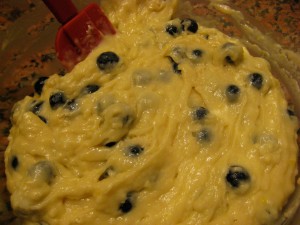
When I was reading the blueberry muffin article in Cook’s Illustrated, the writer had said that she didn’t want her muffin to be “too cake-like,” but at the same time she wanted it to be flaky and soft, but sturdy like a quick bread to hold the weight of the fresh berries. While Blueberry and Kumquat were noshing on the muffins just out of the oven for breakfast yesterday morning, they both said that they didn’t particularly care for muffins that were too cake-like as well, yet to me the crumb of this muffin seemed light and fluffy, as a good cake should be (assuming it’s not one of those dense chocolate ones). How do you describe the ideal muffin texture, and how does it really differ from that of a cupcake other than the fact that your muffin may have berries or nuts in it?

Cake-like or not, these blueberry muffins were probably the best I’d ever had, if I do say so myself. The muffin had just the right amount of fresh blueberries and blueberry flavor throughout, the crumb was delicate yet sturdy, and the lemon zest sugar topping was a beautiful and delicious complement. This recipe is definitely a keeper, and with blueberries at their peak this summer, I will definitely be making these again. I can’t wait to try them with an almond crunch topping.

Best Blueberry Muffins
from Cook’s Illustrated, May & June 2009
Yields 12 muffins
Lemon-Sugar Topping:
- 1/3 cup (2 1/3 ounces) sugar
- 1 1/2 teaspoons finely grated zest from one lemon
Muffins:
- 2 cups (about 10 ounces) fresh blueberries, picked over
- 1 1/8 cups (8 ounces) plus 1 teaspoon sugar
- 2 1/2 cups (12 1/2 ounces) unbleached all-purpose flour
- 2 1/2 teaspoons baking powder
- 1 teaspoon table salt
- 2 large eggs
- 4 tablespoons (1/2 stick) unsalted butter, melted and cooled slightly
- 1/4 cup vegetable oil
- 1 cup buttermilk
- 1 1/2 teaspoons vanilla extract
Stir together sugar and lemon zest in a small bowl until combined; set aside.
Adjust the oven rack to upper-middle position and heat oven to 425 degrees. Spray standard muffin tin with nonstick cooking spray or grease with vegetable oil.
Bring 1 cup blueberries and 1 teaspoon sugar to a simmer in a small saucepan over medium heat. Cook, mashing berries with spoon several times and stirring frequently, until berries have broken down and mixture is thickened and reduced to 1/4 cup, about 6 minutes. Transfer to a small bowl and cool to room temperature, 10-15 minutes.
Whisk flour, baking powder, and salt together in a large bowl. Whisk remaining 1 1/8 cups sugar and eggs together in a medium bowl until thick and homogenous, about 45 seconds. Slowly whisk in butter and oil until combined. Using a rubber spatula, fold egg mixture and remaining cup blueberries into flour mixture until just moistened. The batter will be very lumpy with a few spots of dry flour; do not overmix.
Use an ice cream scoop or a large spoon to divide batter equally among the prepared muffin cups (batter should completely fill cups and mound slightly). Spoon one teaspoon of cooked berry mixture into the center of each mound of batter. Using a chopstick or skewer, gently swirl berry filling into batter using figure-eight motion. Sprinkle lemon sugar evenly over muffins.
Bake until muffin tops are golden and just firm, 17-19 minutes, rotating muffin pan from front to back halfway through baking time. Cool muffins in the muffin pan for 5 minutes, then transfer to a wire rack and cool for 5 minutes before serving.
Note: If buttermilk is unavailable, substitute 3/4 cup plain whole-milk or low-fat yogurt thinned with 1/4 cup milk.
Variation: Blueberry Muffins with Almond Crunch Topping — follow the recipe for blueberry muffins and omit the lemon-sugar topping. Instead, combine 1/3 cup finely ground almonds and 4 teaspoons of turbinado sugar; set aside. For the flour mixture, prepare as usual but add 1/3 cup finely ground almonds. When adding in the vanilla extract, also add in 1 teaspoon of almond extract. Sprinkle the almond topping over muffins before baking.
Addendum: Today (8/24), I actually made the blueberry muffins with this almond crunch topping. Although I didn’t have any turbinado sugar to add to the crunch-top effect and instead used regular granulated sugar, the almond topping was delicious. Here are some of today’s baked photos of this muffin variation:

Here’s a close-up view of a muffin top. I love the way the ground almonds look sprinkled on the top. It looks crusty yet all fluffy at the same time:

Last time I made these muffins with the lemon-sugar topping, I used buttermilk, but this time I wanted to be a little more practical since I knew I wouldn’t use up a whole quart of buttermilk, and I got low-fat yogurt and mixed it with milk instead. The muffins came out perfectly! Recipes from Cook’s Illustrated are amazing — even their substitution ideas are perfect. I will be honest, though, and say that both Blueberry and I prefer the lemon sugar topping. It tends to add more contrast with the sweetness of the muffin and the blueberries, and the color contrast aesthetically is a bit more appealing to me. Try both and let me know which variation you prefer.
Chocolate Lace Cookies
Posted on: June 20, 2009

In January 2005, a friend and I went to visit the Scharffen Berger chocolate factory in Berkeley, CA, just to see what the chocolate making process was all about. Both of us were dessert and baking fanatics who love chocolate and the Bay Area, and we wanted to visit one of the many, many places that made the Bay Area known for its local goods and artisan treats.
The thing that struck me the most about Scharffen Berger was that it was the very first chocolate company I’d heard of that made a point to tell you how much actual cacao, in percentage terms, there was in their chocolate (then again, I wasn’t a big foodie at the time, so I had no clue that amazing chocolate companies like Varlhona existed). Even fancier companies like Ghirardelli at that point in time didn’t tell you how much there was, and it really matters since the more cacao there is in a piece of chocolate, the more intense your chocolate experience will be.

Going on the Scharffen Berger factory tour, I was completely appalled to find out that in order to legally call a piece of milk chocolate “chocolate,” the piece must have at least 10 percent cocoa solids. Yes, you read that right — just 10 percent. A question that might pop into your mind would be — if your milk chocolate bar is only 10 percent chocolate, what’s the other 90 percent consist of? Well, it’s most likely sugar, milk, cocoa butter, lecithins and other emulsifiers. Sounds like a lot of filler to me. The American FDA requirements for bittersweet, semisweet, and dark chocolate are a bit stricter, as bittersweet and semisweet must consist of at least 35 percent cacao, while dark chocolate must have at least 50 percent cacao. So for baking, I’d definitely stick with the bittersweet or dark chocolate over the milk chocolate.

Chocolate is pretty complex, though, as a higher percentage of cacao will not necessarily mean better taste. As the cacao percentage increases, generally the sugar percentage will decrease. Because of this, the chocolate will obviously be less sweet, so many people who consider themselves chocolate fanatics may find a 90 percent cacao bar far too bitter for their tastes.
That happened to me while I was at the Scharffen Berger factory. I realized I wasn’t a huge fan of the 85 to 90 percent chocolate bars, and so since then I’ve been tasting different percentages to see which seemed to have the best balance for baking. For me personally, I have a strong preference for at least 60 percent bittersweet chocolate to a maximum of 70 percent cacao. These will have a very prominent chocolate taste, but also have just enough sugar for balance.

There are also many other considerations for what makes great chocolate, such as the process of roasting and the length of time the cacao beans should be roasted, but to simplify things for this recipe, let’s just aim for 60 to 70 percent cacao in the chocolate you use as the filling, and we’ll be good to go.
After we visited the Scharffen Berger factory, I went to their website to see what kinds of chocolate recipes they had. Out of all of them, the chocolate lace cookie seemed to stand out — it’s an elegant, delicate cookie, the kind of cookie you would see in bakeries and think to yourself, “How pretty! Those look too difficult to make at home…”

My friend was the first to make these cookies, and when she presented them as a gift to me, I couldn’t stop talking about how beautiful they were and decided that I had to try making them. I wasn’t as successful as she was, though, for one big reason: I didn’t use parchment paper the first time. This is a BIG tip in the recipe that you cannot overlook when baking these — use parchment paper or a silpat. These cookies are so incredibly thin and delicate that if you just grease your cookie sheets, these cookies will not come off. They will simply stick to your pan, and the whole baking process will be a complete waste.

The second time I made these (with parchment paper!), they were a big success. They were delicate, dainty, and looked like the professional cookies in bake shops. These chocolate lace cookies are the cookies you would make when you want to dazzle someone with your baking skills. Just be patient with them when taking them off the parchment paper after baking and when sandwiching them with chocolate, and they will come out looking like you put in more effort than you really did.
Another tip I have, which I already changed in my adaptation, is to use less sugar. The original recipe calls for 1 cup of sugar, which just seemed like overkill to me, so I used 1/4 less. I also decreased the amount of cinnamon from 1/2 teaspoon to 1/4 teaspoon, as I wanted the almond/oat combination along with the chocolate to shine. Try playing around with the quantities to see what suits your fancy.

Chocolate Lace Cookies
Adapted from The Scharffen Berger Recipe Collection
Yields about 40 cookies
• 8 tablespoons (1 stick) butter
• 1/2 cup blanched almonds
• 1/2 cup rolled oats
• 3/4 cup sugar
• 1 large egg, lightly beaten
• 1 teaspoon vanilla extract
• 1/4 teaspoon ground cinnamon
• 1/2 teaspoon salt
• 4 ounces 60 to 70 percent Cacao Bittersweet Chocolate
Preheat oven to 350 degrees F. Line baking sheets with Silpats or parchment paper.
Blanch the almonds by putting them in boiling water for 3 minutes and then immediately rinsing in cold water. The skins will pop off. Dry the almonds with paper towels.
In a food processor, place the almonds and pulse until coarsely chopped. Add the rolled oats. Continue pulsing until finely chopped, but not ground as finely as a powder.
Melt the butter. Let it cool slightly.
In a medium bowl, mix together the melted butter, sugar, egg, almond mixture, vanilla extract, salt and cinnamon. Stir to combine.
Drop the batter by teaspoon onto baking sheets. Leave two inches between cookies. Bake until brown, approximately 8 minutes. Cool completely on a wire rack.
In the top of a double boiler or in a bowl placed over simmering water, melt the chocolate. When the cookies are cooled, gently separate them from the Silpat or parchment and flip so the smooth side is facing up. With a spatula, gently spread each cookie with some melted chocolate. Sandwich the cookies together and serve.
Finished cookies can be stored between sheets of waxed paper or foil in an airtight container for up to a week.
Financiers
Posted on: June 7, 2009
- In: Almonds | Browned butter | Cookies | Dessert | Homemade | Sweets
- Leave a Comment

I still have quite a bit of almonds in my pantry, so I thought I’d continue the almond cookie extravaganza and try out the financier recipe in Dorie Greenspan’s Paris Sweets. I’d never had the pleasure of enjoying a financier until about two months ago when Blueberry brought me to T.W. Foods, where at the end of our meal two miniature financier cookies in the shape of madeleines accompanied the check. One bite into this cookie, and I knew I had to call the waitress back to our table and ask her what this little buttery delight was called…
And that was how I learned that I loved financiers.

In a nutshell, financiers came about when a famous Parisian pastry chef named Lasne, whose patisserie was close to the Bourse, Paris’s stock exchange, recognized a problem among his affluent clients: though they were discriminating in taste, they were always in a hurry and rarely had time to sit and enjoy one of his many confections. So Lasne designed this little cake-like cookie so that it could be eaten on the run without the risk of crumbling all over a freshly pressed suit or tie and without a need for a fork or spoon. As Greenspan calls it, financiers are like the “high-class fast food.”

Financiers are as rich as the bankers that they were named for, simply made with ground almonds, sugar, unwhipped egg whites, flour, and a very generous amount of melted butter, which is cooked until it is golden brown. They are traditionally baked in pans that have flat rectangular molds — the reason for this was that the bakers wanted them to resemble little treasured bars of gold — but they are often baked in small boat-shaped molds, madeleine molds, as well as mini muffin pans (especially for people who are not willing to invest in a financier mold pan). My madeleine pan is at my parents’ house, and since I wasn’t willing to buy a real financier mold, I settled on making them in a mini muffin pan — not that I’m dissatisfied at all because I think they turned out quite cute.

These cookies are simple, sweet, and tender, resembling mini cakes rather than cookies. Their nutty flavor comes not only from the ground almonds but especially from the browned butter. When making the browned butter, be sure to keep a close watch over it as it bubbles — aim for a golden brown that is not too dark. If you glance away for just a few seconds, your butter could easy go from brown to black. I’d also recommend using a stainless steel pot to brown the butter instead of a non-stick black bottomed pot; this way, it’s easier for you to watch the butter change color.
Another thing I’d suggest is doubling the recipe — after you taste one of these, I’m sure you’ll have wished that you made more.

Financiers
Adapted from Dorie Greenspan’s Paris Sweets, whose recipe came from Paris’s famous Boulangerie-Patisserie Poujauran
Makes 12 cookies in financier molds, or 24 cookies in mini muffin pans
1 1/2 sticks (6 ounces) unsalted butter
1 cup minus two tablespoons sugar
1 cup ground, toasted almonds
6 large egg whites
2/3 cup all-purpose flour
Put the butter in a small saucepan and bring it to a boil over medium heat, swirling the pan occasionally. Allow the butter to bubble away until it turns a deep brown, but don’t turn your back on the pan – the difference between brown and black is measured in seconds. Pull the pan from the heat and keep it in a warm place.
Mix the sugar and almonds together in a medium saucepan. Stir in the egg whites, place the pan over low heat, and, stirring constantly with a wooden spoon, heat the mixture until it is runny, slightly white and hot to the touch, about 2 minutes. Remove the pan from the heat and stir in the flour, then gradually mix in the melted butter. Transfer the batter to a bowl, cover with plastic wrap, pressing it against the surface of the batter to create an airtight seal, and chill for at least 1 hour. (The batter can be kept covered in the refrigerator for up to 3 days).
Center a rack in the oven and preheat the oven to 400 degrees F (200 degrees C). Butter 12 rectangular financier molds (1 pan with 3-3/4 x 2 x 5/8-inch [10 x 5 x 1-1/2-cm] rectangular molds that each hold 3 tablespoons, or you can use a mini muffin pan like I did), dust the interiors with flour and tap out the excess. Place the molds on a baking sheet for easy transport.
Fill each mold almost to the top with batter. Slide the molds into the oven and bake for about 12-13 minutes, or until the financiers are golden, crowned and springy to the touch. If necessary, run a blunt knife between the cookies and the sides of the pans, then turn the cookies out of their molds and allow them to cool to room temperature right side up on cooling racks.
Note: Although the batter can be kept in the refrigerator for up to three days, financiers are best enjoyed the day they are baked.
Mexican Wedding Cookies
Posted on: June 1, 2009

I’ve been perusing all of the cookie and dessert recipes that I have to pick out recipes that will allow me to put a bigger dent into the five-pound bag of almonds that I have, and I came across one cookie recipe for which I’ve often received compliments: Mexican wedding cookies.
According to traditional Mexican culture, when a couple is married, each of these cookies is wrapped in brightly colored tissue paper, or papel de china, as it is called in Mexico. The cookies are then piled into baskets or cellophane bags and tied with silk ribbons. They are then passed out at the wedding dinner to guests. Although incredibly laborious in terms of the careful packaging and homemade nature of cookie baking, preparing these cookies is an old custom — one that is much loved by those who are lucky enough to receive them as treats.

But who says you have to go to a Mexican wedding to enjoy these tasty delights? I’ve made them for my family and friends numerous times, and I knew that they were a winner when my uncle, who usually happily eats the cookies I’ve made for him in silence, e-mailed me shortly after I sent him away with a bag of these cookies and wrote, “What on earth are those little cookies with powdered sugar on them called? They’re amazing!” If someone writes to you to point out how great a cookie is, it must be good. So now whenever I see him and have access to baking supplies, I always make sure to bake a mini batch just for him.
I originally found this recipe in a feature story written by Jacqueline Higuera McMahan in the San Francisco Chronicle several years ago. Lamenting the disappearance of old customs due to the passage of time and the modernization of today’s society, McMahan wanted to revive the tradition of making Mexican wedding cookies when her son was to marry. In her small kitchen all within one day’s time, she handmade 300 of these sweets. Three-hundred! Some of you will think it’s ridiculous to labor over something so seemingly frivolous, but I consider that an act of love.

You can use either pecans or almonds to make these cookies, but I’m sure that if you use pecans, the cookie will be a bit richer because the natural fat content of pecans is a higher. McMahan uses vanilla and almond extracts as her main flavoring additions, but I’ve read that you can also use other flavored extracts or even kahlua.

The recipe itself isn’t that clear regarding how to shape the cookies, so I’ll share what I usually do: I’ll take a walnut-sized (the actual shell size, not the itty nut itself!), roll it into a ball, and then flatten it just slightly onto the cookie sheet. The sheets do not need to be greased since the butter content is very high.
The resulting cookie is very crumbly, dry, and lightly sweetened by a small amount of powdered sugar in the dough as well as on the tops. These cookies are best enjoyed with a cup of coffee or tea, or as a slightly indulgent snack anytime during the day.

Mexican Wedding Cookies
From Jacqueline Higuera McMahan’s California Rancho Cooking
Yields 33-35 cookies
- 1 cup pecans or almonds, toasted
- 2 cups all-purpose unbleached flour
- Pinch of salt
- 1 cup unsalted butter, slightly softened
- 1/2 cup powdered sugar
- 1 1/2 teaspoons pure vanilla
- 1/4 teaspoon almond extract
- 1 1/4 cups powdered sugar placed in sifter for dusting cookies
Place the toasted nuts, 1 cup of the flour and a pinch of salt into the bowl of a food processor. Lightly grind. The nuts do not have to be really fine. The flour keeps the nuts from becoming too pasty.
In the bowl of a mixer, place the butter and powdered sugar. Beat until well combined, then add the vanilla and almond extracts. Beat just to mix, and then begin adding the flour-nut mixture by 1/2 cupfuls.
Blend in the remaining 1 cup flour and mix just until a dough is formed. If there are dry bits at the bottom of the bowl, use a large spoon to blend or blend with your hands. Cover the bowl with plastic wrap and chill the dough for 30 minutes.
Preheat oven to 350°.
Place walnut-size pieces of dough on Silpat or a parchment-lined baking sheet. Bake for about 18 minutes, or until the edges of the cookies are golden. Cool on racks for 10 minutes.
Dust a sheet of waxed paper with powdered sugar. Place the cookies on top of the sugar and sift more powdered sugar over all. Let them cool and then store in tins. Serve as is or wrap each cookie in an 8-inch square of colored tissue like red, pink, blue, yellow and purple.
Old-Fashioned Almond Cookies
Posted on: May 26, 2009

I’ve recently become a happy and proud recipient of a five-pound bag of California-grown almonds, courtesy of Blueberry and his much beloved Costco membership. Stores that we love and will continue to love include Trader Joe’s, Costco, and any place that sells 83 percent-plus butterfat butter/Mariage Frères tea (me) or the purest, fruitiest Italian olive oils (Blueberry).

I’ve always loved almonds, particularly right after they’ve been toasted and the air is filled with a subtle, sweet, nutty aroma. They are one of the most versatile nuts for baking and pair amazingly well with almost every fruit imaginable. They are amazing whole, sliced, ground, chopped, and somehow they always look so elegant just simply on their own. It’s like they were meant to be showcased in dessert.

Today I’m not really going to wow anyone with the dessert that I’ve made with a small part of that five-pound bag – I actually wanted to make something simple with just a few ingredients to allow that pure almond flavor to really shine through. The first dessert that came to mind was the old-fashioned almond cookie made the French way with only three ingredients: almonds, sugar, and egg whites.
This cookie is like the French macaron’s far less fussy sister – yes, it uses ground almonds, but it doesn’t need any piping from a pastry bag, nor do the cookie drops need to rest and develop a skin before baking the way a traditional macaron would. You don’t even need an electric mixer or a whisk – just a fork to stir together the ingredients and you’d be good to go. I’ve copied the recipe below from the book, but what I actually did was I ground the almonds in a food processor, then mixed that in a bowl with the sugar, cinnamon, and egg whites. I did this because my food processor wasn’t big enough, but if you’d like, you could just follow the recipe’s directions. I also adjusted the sugar (the original recipe calls for 1 cup, but I used 2/3 cup).

I found these cookies in a popular dessert book put together by Dorie Greenspan, who gallivanted all over Paris to find the most exquisite and loved desserts that the city of love (and sweets) had to offer. This recipe is from Arnaud Larher’s patisserie, where the batter is used to not only make these cookies but also to fill tartlets. Greenspan suggests either eating them au naturel or flavored with a little cinnamon, cocoa, or nuts. This time around I decided to add a half teaspoon of cinnamon to the mix, and I loved it (and so did Blueberry). They go great with coffee, tea, or just plain by themselves. This is as pure as an almond cookie can get.

Old-Fashioned Almond Cookies (Amandines à L’Anciennes)
From Dorie Greenspan’s Paris Sweets
Makes about 24 cookies
- 8½ ounces (just under 2 cups) toasted and blanched almonds
- 1 cup sugar
- 1 teaspoon ground cinnamon, 3 tablespoons (20 grams) unsweetened cocoa powder, and/or 1 cup (50 grams) finely chopped pecans, to flavor (optional)
- 3 large egg whites, lightly beaten with a fork
Position the racks to divide the oven into thirds and preheat the oven to 375°F (190°C). Line two baking sheets with parchment paper and keep them close at hand.
Put the almonds and sugar in the work bowl of a food processor fitted with the metal blade and pulse, scraping down the sides of the bowl now and then, until the almonds are finely ground, about 2 minutes. If you are using cinnamon or cocoa, put it in now and pulse to blend. If you are using chopped pecans, wait to add them after all the other ingredients have been added.
With the processor running, add the egg whites in a steady stream. Mix about 30 seconds, only until the egg whites are blended into the almonds and sugar— you don’t want to incorporate too much air into the batter. Add the pecans, if you are using them, and pulse just to mix.
Spoon out a level tablespoon of batter for each cookie, spacing the cookies about 1 inch (2.5 cm) apart on the lined baking sheets. Slide the baking sheets into the oven and bake for 18 to 20 minutes, rotating the sheets front to back and top to bottom at the halfway point. The cookies should puff, firm, and turn lightly brown around the edges. With a wide metal spatula, carefully lift the cookies off the baking sheets and onto cooling racks to cool to room temperature.
Tomato Egg Drop Soup
Posted on: May 17, 2009
- In: Dinner | Eggs | Homemade | Savory | Soup | Tomatoes | Vietnamese
- Leave a Comment

One of the fondest childhood food memories I have is eating stir-fried tomato and egg made by my grandma. It’s one of the Chinese comfort food staples that is often made at home, particularly when time is not plentiful and stomachs are growling for food as soon as possible. It’s simple, fast, and light, and assuming you use fresh, fragrant, bright red tomatoes, the pure flavors of the tomatoes and eggs really shine through with just the right amount of seasonings.

Although I have always loved stir-fried tomato and egg, once my grandma died when I was about nine years old, I suddenly forgot that I ever ate it. After her passing, no one ever made it for me again, and it was as though the dish had died with her. It seemed like life had always been this way — empty and without one of my favorite foods, my beloved fan qie chao dan (番茄炒蛋).
Then I went to China 11 years later, and it was appearing at restaurant tables everywhere I ate. And as soon as I saw it, it was as though a light bulb had popped into my head, blinking and screaming, “you used to eat this, remember? How the heck did you forget?” One bite (and then a hundred later), and I had fallen in love all over again with the simplicity and purity of the dish. I was home again with my grandma.

Comfort foods like tomato and egg often have different variations within the culture and in surrounding regions, and one that I have recently found and enjoyed has been Andrea Nguyen’s tomato egg drop soup. In Into The Vietnamese Kitchen, Nguyen discusses the origins and influences of many Vietnamese dishes, and it’s no doubt that many Vietnamese traditions and foods have strong Chinese influences.
The ingredients for the recipe are incredibly simple, little more than tomatoes, eggs, onions, and of course, a key Vietnamese ingredient that makes this soup Vietnamese, fish sauce. My favorite brand of Vietnamese fish sauce is this Three Crabs brand. Apparently the employees (who are not Vietnamese) at Hong Kong Supermarket near my apartment even know about this stuff; as I picked up a bottle of it in one of the aisles, one of the Chinese guys goes nuts and starts raving and raving about it in Chinese and how it’s the best of the best! I knew that already, though.

Use the freshest, reddest, most fragrant tomatoes you can find. If it smells like a tomato, then it will taste like a tomato. I’ve really been upset at the tomato industry for producing such tasteless “tomatoes” and almost gave up until my roommate Kumquat came home with some red beauties from Trader Joe’s. Thanks to her, I’m currently in love with these TJ’s baby Roma tomatoes. They are small, cute, and blazing red. The last two times I’ve made a trip there, I’ve left with at least three to four boxes of these babies. What can I say — I’m a fan.

Lastly, if you don’t have ground pork on hand (and I usually don’t), ground turkey makes a fine substitute. This soup really embodies the pure flavors of the egg and tomato. Adding the egg at the end lends the soup a really satisfying richness, as does the ground pork. It’s a healthy and refreshing first course to a multi-course Vietnamese dinner.

Tomato Egg Drop Soup / Canh cà chua trứng
Adapted from Andrea Nguyen’s Into the Vietnamese Kitchen
Serves 4 to 6 with 2 or 3 other dishes
• 1 1/2 tablespoons canola oil
• 1 small yellow onion, thinly sliced
• 3/4 pound very ripe tomatoes, cored and coarsely chopped
• 3/4 teaspoon salt
• 1/3 pound ground pork coarsely chopped to loosen
• 4 cups water
• 2 eggs, beaten
• 5-6 springs cilantro, coarsely chopped for garnish (optional)
• Black or white pepper
In a 4-quart saucepan, heat the oil over medium heat. Add the onion and cook gently, stirring occasionally, for about four minutes, or until fragrant and soft. Add the tomatoes and salt, cover, and cook for 4 to 6 minutes, or until the tomatoes have collapsed into a thick mixture. Stir occasionally and, if necessary, lower the heat to prevent the tomatoes from sticking or scorching.
Uncover and add the fish sauce and pork. Wield chopsticks or use a spoon to move the pork around the pan so that it breaks up into small pieces. This will make it possible to distribute the pork evenly among the bowls when serving. Add the water, raise the heat to high, and bring to a boil, using a ladle to skim and discard any scum that rises to the surface. Lower the heat to a simmer and cook, uncovered, for 15 to 20 minutes, or until the flavors have developed and concentrated sufficiently to produce a rich broth. If you are not serving the soup right away, turn off the heat and cover.
Just before serving, return the soup to a simmer. Taste and add extra salt or fish sauce, if necessary. Turn off the heat. Pour the beaten egg onto the soup in a wide circle, and then stir gently to break it up into chiffon-like pieces. Ladle the soup into a serving bowl. Garnish with the cilantro and a generous sprinkle of pepper and serve immediately.
Blueberry Buttermilk Pancakes
Posted on: May 10, 2009
- In: Blueberries | Breakfast | Homemade | Pancakes | Sweets
- 2 Comments

I have always loved breakfast foods — the classic American ones that include omelettes and pancakes, ethnic morning nourishments like jook (rice porridge) and freshly pressed soybean milk, and the rich, decadent ones, like a simple cafe au lait and un pain au chocolat. As the first meal of the day, breakfast should be a cherished meal, one that makes you think, “Mmm, it’s great to be alive and start the day!” It sounds corny, but I really believe it.

Too often people succumb to forgetting about breakfast, insisting that they don’t need to eat before they rush out the door, or just grabbing a cereal bar (I hate these!) or a banana (well, this is better since it’s a fruit). I’m not going to lie; most times when I haven’t had enough sleep and am in a hurry to get to work, I just eat a bowl of Kashi cereal, a banana, and leave the apartment. Why would I set aside 45 minutes of precious sleep in the morning to prepare steel-cut oats?
But then I stumbled upon an article in a recent issue of Gourmet magazine that raved about a cookbook that was all about the first meal of the day. In The Breakfast Book, Marion Cunningham, in her own, tantalizing way, makes a case for breakfast and why we shouldn’t forgo the most important meal of the day. She includes a large array of recipes, including quick breads and yeast breads, custards and puddings (yes, for breakfast!), and of course, the beloved pancakes.

I have tried about seven different pancake recipes from this book, and I will say now that all of them were delicious and incredibly simple. Contrary to popular belief, preparing your own pancake batter is very simple and easy, and if you prepare the batter the night before, which I’d recommend, it would even be easier than using a mix. And the taste of a pancake from a mix could never be compared to that made from scratch, but that should go without saying (no offense to those of you who are IHOP fans).

Of all of the pancake recipes I tried from the book, I must say that my favorite is not terribly unique or exotic – they’re the classic buttermilk pancakes. I guess some things are classic for a reason; they have just the right tang from the sour buttermilk and are soft, fluffy, and perfect with pure maple syrup. Cunningham’s recipe doesn’t use any sugar, but I like to add about two teaspoons for a very subtle sweetness. Blueberries make these pancakes even better; I use the frozen wild Boreal blueberries from Trader Joe’s since fresh blueberries are not in season right now. The easiest way to add berries to the pancakes is to add them as the first side of the pancake is being cooked. Once you see bubbles forming on the pancake tops, lightly sprinkle the blueberries evenly on top.

Another tip for the pancakes: to ensure a light and fluffy texture, do not over-mix the batter. You want to mix the wet and the dry ingredients until just incorporated. If you see lumps, you can jump up and down in giggly glee because your pancake batter is good to go. This pancake recipe is perfect for making ahead of time — it keeps in the refrigerator for days.

Buttermilk Pancakes with Blueberries
Adapted from Marion Cunningham’s The Breakfast Book
Yields about 9 pancakes
• 1 cup buttermilk
• 1 egg, room temperature
• 3 tablespoons melted butter, slightly cooled
• 3/4 cup all-purpose flour (or 1/2 cup whole wheat flour and 1/4 cup all-purpose flour)
• 1/2 teaspoon salt
• 1 teaspoon baking soda
• 2 teaspoons sugar
• 1/2 cup blueberries
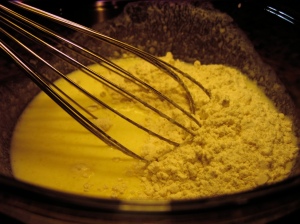
Place the buttermilk, egg, and melted butter into a medium-sized mixing bowl. Stir briskly until the mixture is smooth and blended.
Stir together the flour, salt, baking soda, and sugar into the buttermilk mixture only until the dry ingredients are moistened — remember to leave lumps, and do not over-mix.
Grease the skillet lightly with butter and set to medium heat. Spoon out about 2 generous tablespoons per pancake. After about 1-2 minutes, you will see bubbles beginning to form on the pancake tops. Gently sprinkle blueberries on top of the pancakes and push down lightly. Then gently flip over with a spatula and cook the other side for about 1-2 minutes.
Serve with pure maple syrup and additional blueberries.

